~1 hourCollection and entry effort per operating day
Our continuing commitment
Every day on the water adds to the story
Since 1992, the wider marine mammal record has preserved
observations from Queen Charlotte Sound / Tōtaranui.
Today, guides and crew on E-Ko Tours continue recording
dolphin encounters during their tours.
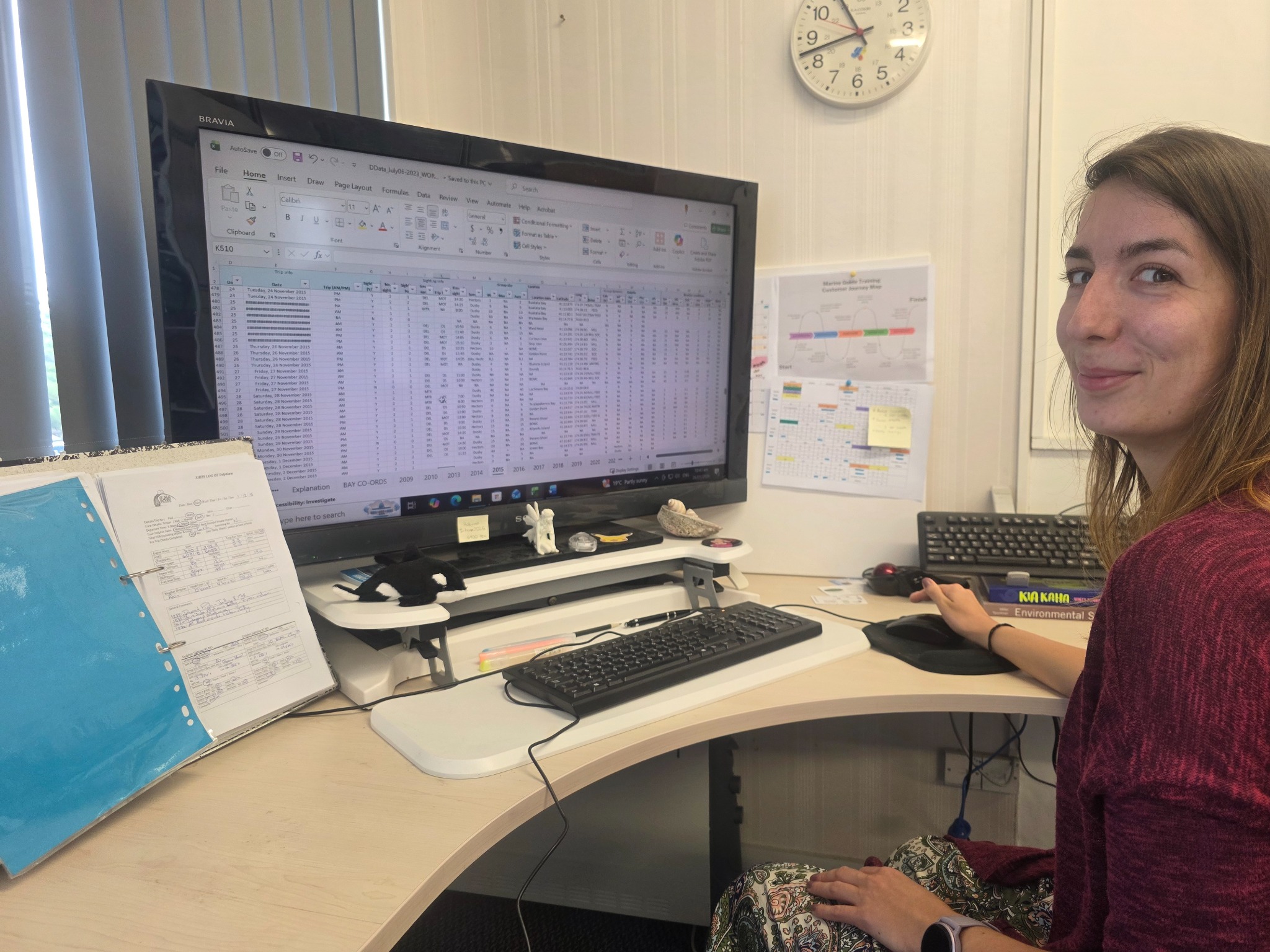
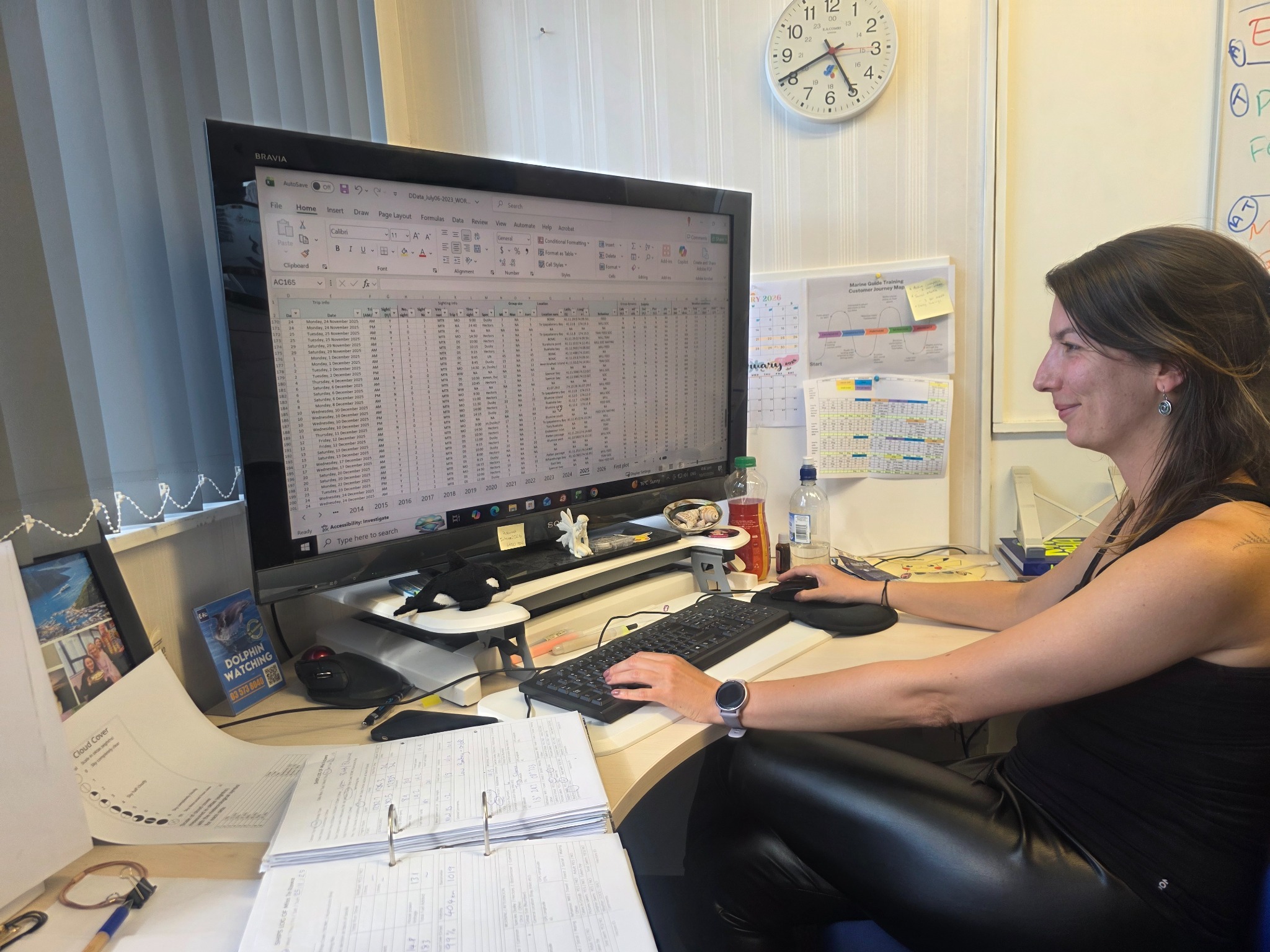
These observations are entered into a database, building
a picture of where animals are seen, when they visit
and what they are doing.
Sounds Enhancement connects this practical work with
education, research and community care for the Sounds.
Staff, researchers and interns all contribute to keeping
the record useful for the next generation.
The outer Marlborough Sounds and islands: part of the
wider setting for marine mammal observations in
Queen Charlotte Sound / Tōtaranui.
Behind every record
From daily observation to lasting evidence
Observe:
Guides and crew watch for marine mammals during tours.
Record:
Sighting sheets capture the encounter and its context.
Enter and check:
Written observations are transferred into the digital record.
Investigate:
Researchers assess suitable records to explore distribution,
habitat use and patterns through time.
The programme’s documented fields include date, trip,
vessel, species, location, group size, behaviour and
environmental conditions. The protocol also provides
for trips with no sightings.
Historical field coverage varies. Collection and digitisation
are separate stages: original paper logs preserve observations
while they await entry.
Research built on the record
Supporting scientific understanding
Dr Cheryl Lynne Cross
Massey University · PhD, 2019
Cheryl’s research examined dolphin occurrence,
distribution, habitat use and regional swim-with-dolphin
tourism in Queen Charlotte Sound.
It drew on historical tour logbooks from 1995–2011
alongside separate vessel-based survey work from
2011–2014.
Spatial ecology of delphinids in Queen Charlotte
Sound, New Zealand: Implications for conservation
management.
Assessment of Hector’s dolphin distribution within
Queen Charlotte Sound, New Zealand:
Implications for Conservation and Management.
This preliminary work explored distribution and habitat
use, including spatial analysis of records from 2016–2019.
Continuing the assessment offers a useful opportunity
for a new researcher to review the methods, check later
records and investigate whether earlier patterns persist.
Tour routes, weather, season and search effort affect
sightings. More recorded encounters alone do not establish
a larger population. Research must consider gaps,
observation effort and changes in methods.
Decades of practical investment
A long-term record with lasting value
NZ$1.3 million
E-Ko estimates the complete marine mammal dataset’s
replacement cost at NZ$1.3 million. The record represents
sustained observation, vessel access, staff effort
and data management since 1992.
A new monitoring programme can collect new observations.
It cannot recreate the historical conditions and
encounters already recorded.
E-Ko estimates around one hour per operating day for
collection and data entry, alongside the vessel platform
that makes observations possible. Training, checking,
digitisation and maintenance add further ongoing effort.
The replacement-cost figure is supplied by E-Ko.
It applies to the complete dataset, not the partial
working copy reviewed for digitisation planning.
It is separate from a sale valuation or research licence fee.
Learning that makes a contribution
Interns help turn observations into evidence
Research internships connect learning with practical work.
Interns help enter and check ships’ logs, document questions
and bring more of the collected record into a form that
researchers can use.
Careful data entry connects the original ships’ logs
with the digital marine mammal record.
From hard-copy ships’ logs and daily observations
to a usable digital dataset.
Learn:
Species identification, observation methods and careful
data handling.
Contribute:
Enter records, check details and document gaps.
Investigate:
Work towards a focused project with suitable supervision.
Share:
Prepare a report, poster or community summary and
leave a clear handover.
Placements, supervision, duration and availability
are agreed individually.
Digitisation progress and the partial working copy
The archived working copy reviewed in November 2026
is not the complete database and does not establish
the current coverage of the master record.
It contains 4,869 populated log rows, including
no-sighting trips. Its latest observation is dated
10 March 2022. The July 2023 update note relates to
entry of older 2014 logs; the 2023 tab has no data rows.
Using 342 rows from 2021 as an illustrative annual
baseline gives a projected working-copy total of
approximately 6,500 records through December 2026:
4,869 existing rows, plus a 263-row allowance for
the remainder of 2022, plus 1,368 rows for 2023–2026.
This is a planning estimate within that working-copy
scope. It excludes older gaps and records held elsewhere.
It is not the size of the complete database.
Rows have not been fully validated or deduplicated,
and log rows are not counts of individual animals.
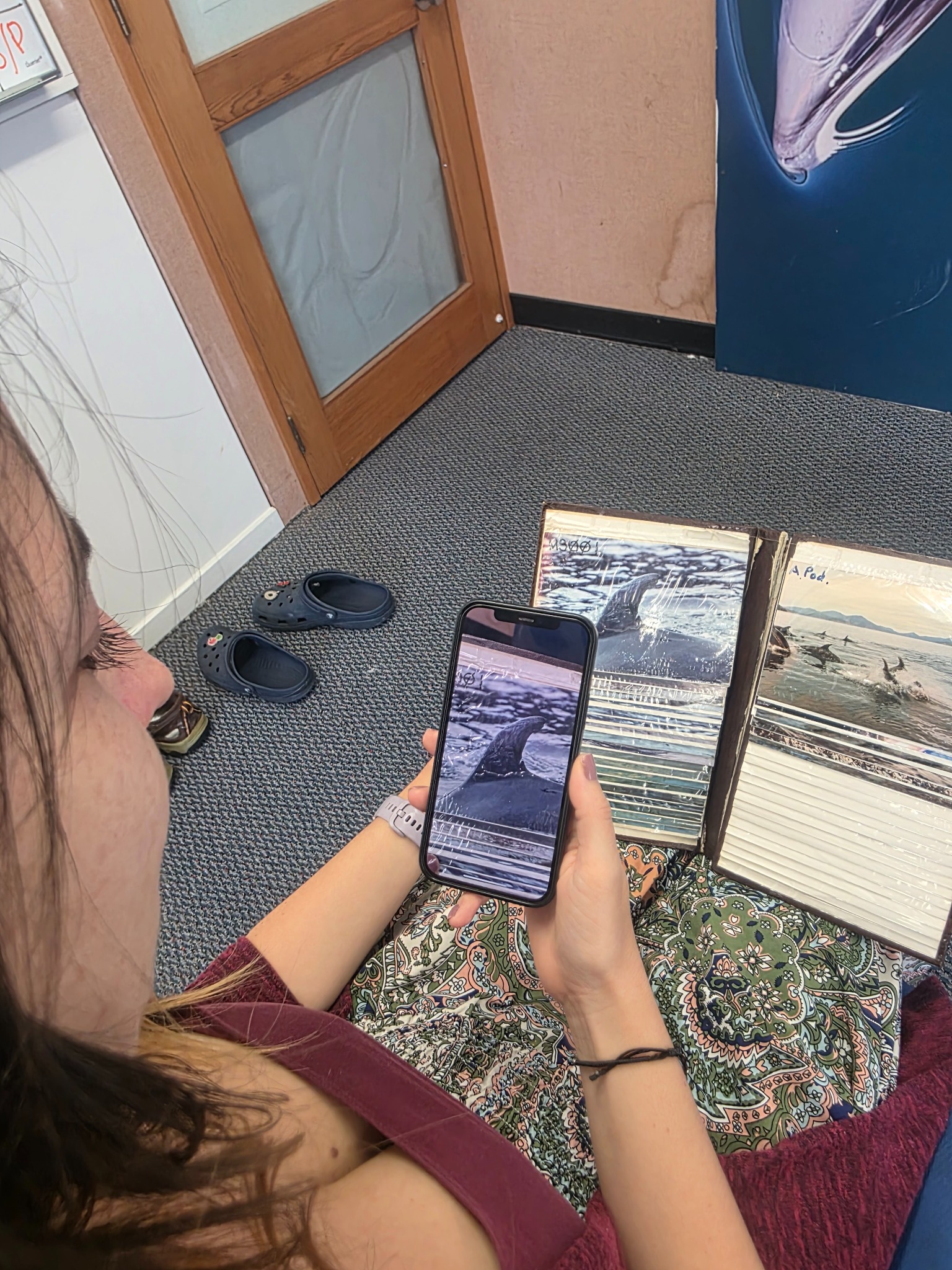
Checking the historical Fin ID collection, which includes
photographs dating back to 1996.
Looking back to learn more
Old photographs. New research questions.
Historical fin-identification photographs provide a
complementary record alongside written observations,
including images dating back to 1996.
Reviewing original images can help researchers explore
individual identification and the history behind
the programme.
Suitable photographs require careful matching and
quality assessment before conclusions can be drawn.
We welcome discussion with the Department of Conservation,
Marlborough District Council, mana whenua and universities
about appropriate research and collaboration.
Involving MDC in the database is a future goal.
We want our community to understand the daily work
and see how it can support learning and better-informed
care for the Sounds.
This work supports Sounds Enhancement’s four foundations:
Protect, Restore, Enhance and Educate.
The enrolment link includes code SEP. If needed,
enter SEP at checkout and check that the total
is NZ$0 before enrolling. Create an account or
log in to access the course.
Offer ends 16 November 2028, subject to coupon availability.
Help the record keep growing
Support, learn or collaborate
Support the practical work, discuss an internship
or explore a university research collaboration.
Research access is by arrangement.
The complete database is managed separately from this
website. Raw database files and direct database access
are not provided here. Approved research use requires
agreement with the data custodian.
Sources and acknowledgements
Programme history and methods: E-Ko / WCA research
internship and Scientific Methods material, 2020.
Research milestones: Cheryl Lynne Cross’s 2019
Massey University thesis and the preliminary assessment
by Danielle Spencer and Miranda van der Linde.
Daily effort, replacement-cost estimate and historical
Fin ID date supplied by Paul Keating, E-Ko.
Partial working-copy figures are from the supplied
July 2023 workbook. Photographs are from Sounds
Enhancement and Paul Keating’s supplied original images.
Sounds Enhancement · Queen Charlotte Sound / Tōtaranui